.webp)

Keep Pests Away From Your Home
Wet leaf litter sitting in a gutter is nesting material and standing water. Gutter protection keeps most of that debris out of the trough in the first place.
Protect Your Home TodayHow Clogged Gutters Attract Pests
Clogged gutters hold water and organic debris. That combination attracts mosquitoes, birds, rodents and insects, and a debris-loaded gutter also gives them a sheltered path along the roofline of your home.
Warning Signs of Pest Problems
- ✓Standing water in gutters
- ✓Mosquito swarms near home
- ✓Visible nests in gutters
- ✓Bird or rodent activity on roof
- ✓Insect infestations near gutters
- ✓Unusual pest noises in walls
- ✓Visible pest entry points
Standing water in the trough
Mosquitoes need very little water to breed, and a gutter that holds a shallow pool between rains provides it. Florida winters are mild enough that this does not stop for the season the way it does further north.
The insects do not stay on the roof. They spread across the yard, which is usually how a homeowner discovers the gutter is holding water at all.
Debris as nesting material and a route inside
Packed leaves and pine needles are ready-made nesting material for birds, and a nest in the trough blocks drainage further. Rodents use loaded gutters and sagging sections as footing along the perimeter of the roof while they look for a way into the attic.
Where fascia has softened from repeated overflow, the gap between the gutter and the roof edge becomes an entry point, which is why pest activity and water damage often turn up together.
Moisture-damaged wood attracts different problems
Carpenter ants excavate softened wood rather than sound wood, so damp fascia and roof decking are easier for them to work. Damp conditions near the foundation are also what draw ants and other insects to the base of the house.
Treating the insects without drying out the wood leaves the conditions in place. Keeping the gutter draining is the part of that a gutter company can actually fix.
What gutter protection changes
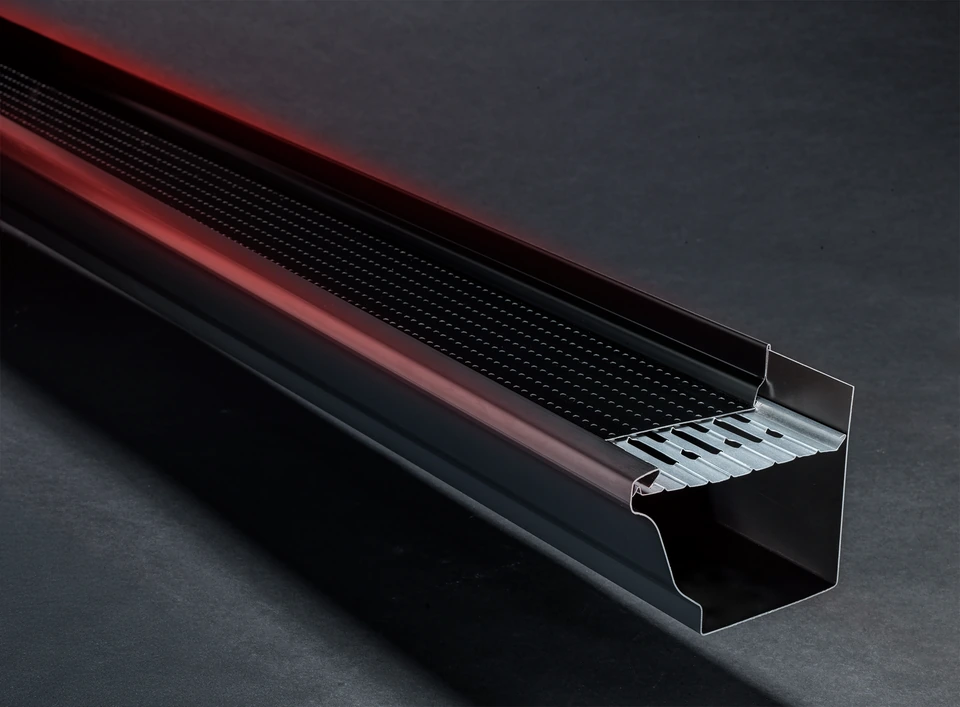
Clean Gutter Protection is a dual-layer perforated aluminum guard with integrated support along the gutter. It is built to keep leaves and pine needles out of the trough so roof water keeps moving to the downspout instead of over the edge.
It is not a substitute for the rest of the system. Gutters that are undersized, pitched wrong or pulling away from the fascia need to be corrected first, and gutters under heavy tree cover may still need occasional clearing.
What happens at the assessment
An installer walks the roofline, looks at how your current gutters drain, and confirms whether the guard fits the gutters you have or whether new gutters are the better starting point.
You get a written, itemized estimate covering the gutter run and the guard system together. Nothing is ordered or scheduled until you approve it.
Request a free assessment and get a written estimate for your roofline.
What the Installed System Does
Keeps leaves and pine needles out of the trough
Keeps roof water moving to the downspout
Less time on a ladder clearing gutters
Perforated aluminum, not plastic screen
Integrated support along the gutter
Lifetime limited product warranty
Clean Gutter Protection
Two layers.
Less time on a ladder.
Help keep leaves and pine needles out while rainwater drains through: two perforated aluminum layers with offset openings, carried by integrated support along your roofline.
Lifetime limited product warranty.